 Oldest Train Store In America, est. 1909
ATLAS
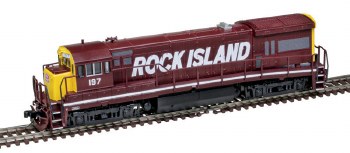
N U33B ROCK ISLAND LOCOMOTIVE
Product code: 40005931Description
Atlas Master Gold Series N 40005931 DCC/ESU LokSound V5 Equipped GE U33 Locomotive Rock Island RI #197 Features:
All New Tooling
Factory-installed AccuMate magnetic knuckle couplers
Blackened metal wheels
Scale Speed motor
Accurate painting and lettering
Optional separate electrical equipment box will be included on the left side walkway behind the cab per the prototype
AAR-B or Blomberg trucks will be used when appropriate
SILVER SOUND READY FEATURES (SILVER LOCMOTIVES ONLY):**
Sound ready & equipped with speaker for easy conversion to DCC sound.
EC24 DCC Plug Equipped
DCC OPERATION FEATURES (GOLD LOCOMOTIVES ONLY):**
Supports all DCC-programming modes
DCC includes RailCom and RailComPlus, with 14, 28 or 128 speed steps and with 2-digit and 4-digit addressing.
Flexible mapping of function keys F0 to F28.
A total of 6 DCC function outputs are available, and all can be function mapped (disable, brightness, light effects) individually
Follows all NMRA DCC standards and recommended practices**
SOUND FUNCTIONALITY FEATURES (GOLD LOCOMOTIVES ONLY):**
Over 20 sound effects are available, including engine start-up and shutdown, prime mover sounds through all eight notches, bell, air horn, air compressor, dynamic brakes and more.
There are up to 16 user-selectable horns, 2 user-selectable bells, and 2 user-selectable synchronized brake squeals.
Equipped with ESU’s Exclusive “Full Throttle” features for ultimate realism in prototype running.**
**Lombard Hobbies Recommendation - As modelers ourselves we highly recommend ONLY running DCC on DCC systems and DC on DC systems, regardless of 'Dual-Mode' capability. This gives optimum performance and safeguards the unit from possible damage from running on a different system than originally intended and from any inexperienced operator errors.
Prototype Information:
The horsepower race was in full swing by the late 1960s when GE introduced the 3,300hp, four-axle U33B locomotive. 137 units were produced between September 1967 and August 1970 when production ended. GE upped the horsepower ante in 1970 with the introduction of the 3,600hp U36B which was produced between May 1970 and December 1974. Both models were externally identical, and internally they were both powered by the same GE FDL-16 cylinder four-stroke engine. The horsepower increase was achieved through adjustments to the fuel rack settings and other internal component changes. One key spotting feature of both models was the built-out radiator “wings” on the long hood.
Model Information:
Atlas’ U33B and U36B model is being offered in both an early and late phase. The early phase model includes flushmounted radiator screens and air intake screens on the long hood. In addition, there is a built-out area on the top of the front and rear pilots. Late phase models include corrugated radiator and air intake screens, with a flat pilot face. An optional separate electrical equipment box is included on the left side walkway behind the cab per the prototype. AAR-B or Blomberg trucks are used when appropriate.
All New Tooling
Factory-installed AccuMate magnetic knuckle couplers
Blackened metal wheels
Scale Speed motor
Accurate painting and lettering
Optional separate electrical equipment box will be included on the left side walkway behind the cab per the prototype
AAR-B or Blomberg trucks will be used when appropriate
SILVER SOUND READY FEATURES (SILVER LOCMOTIVES ONLY):**
Sound ready & equipped with speaker for easy conversion to DCC sound.
EC24 DCC Plug Equipped
DCC OPERATION FEATURES (GOLD LOCOMOTIVES ONLY):**
Supports all DCC-programming modes
DCC includes RailCom and RailComPlus, with 14, 28 or 128 speed steps and with 2-digit and 4-digit addressing.
Flexible mapping of function keys F0 to F28.
A total of 6 DCC function outputs are available, and all can be function mapped (disable, brightness, light effects) individually
Follows all NMRA DCC standards and recommended practices**
SOUND FUNCTIONALITY FEATURES (GOLD LOCOMOTIVES ONLY):**
Over 20 sound effects are available, including engine start-up and shutdown, prime mover sounds through all eight notches, bell, air horn, air compressor, dynamic brakes and more.
There are up to 16 user-selectable horns, 2 user-selectable bells, and 2 user-selectable synchronized brake squeals.
Equipped with ESU’s Exclusive “Full Throttle” features for ultimate realism in prototype running.**
**Lombard Hobbies Recommendation - As modelers ourselves we highly recommend ONLY running DCC on DCC systems and DC on DC systems, regardless of 'Dual-Mode' capability. This gives optimum performance and safeguards the unit from possible damage from running on a different system than originally intended and from any inexperienced operator errors.
Prototype Information:
The horsepower race was in full swing by the late 1960s when GE introduced the 3,300hp, four-axle U33B locomotive. 137 units were produced between September 1967 and August 1970 when production ended. GE upped the horsepower ante in 1970 with the introduction of the 3,600hp U36B which was produced between May 1970 and December 1974. Both models were externally identical, and internally they were both powered by the same GE FDL-16 cylinder four-stroke engine. The horsepower increase was achieved through adjustments to the fuel rack settings and other internal component changes. One key spotting feature of both models was the built-out radiator “wings” on the long hood.
Model Information:
Atlas’ U33B and U36B model is being offered in both an early and late phase. The early phase model includes flushmounted radiator screens and air intake screens on the long hood. In addition, there is a built-out area on the top of the front and rear pilots. Late phase models include corrugated radiator and air intake screens, with a flat pilot face. An optional separate electrical equipment box is included on the left side walkway behind the cab per the prototype. AAR-B or Blomberg trucks are used when appropriate.
Reviews
Customer Reviews
This product has not yet been reviewed.
Share:
Share on Facebook Share on Twitter Share on Pinterest Tell a friend