 Oldest Train Store In America, est. 1909
Pre-Order
ATLAS O
O PREMIER 70' STREAMLINE PASSE
Product code: 3001949
$574.99
Description
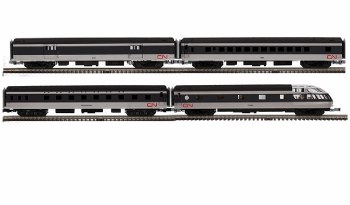
O Premier 70' Streamline Passenger Canadian National 4 car set
(Baggage #9109, Sleeper Buckley Bay, Caoch #5407, Skytop Observation-Fundy) Black/White/Red - 3RL
Features
The perfect match for our E6 Locomotives
Based on Budd designs
Intricately Detailed, Durable ABS Bodies
Stamped Metal Floors
Detailed Car Undercarriage
Colorful, Attractive Paint Schemes
Metal Wheels and Axles
Die-Cast 4-Wheel Trucks
Fast-Angle Wheel Sets
Needle-Point Axles
(2) Operating Die-Cast Metal Couplers
O Scale Kadee-Compatible Coupler Mounting Pads
Constant Voltage Overhead LED Interior Lighting
End-of-Car Diaphragms
Separate Metal Handrails
Detailed Car Interiors
Sliding Baggage Car Doors
Detailed Brake Wheel
1:48 Scale Proportions
Unit Measures: 19” x 2 7/16” x 3 1/2”
Operates On O-42 Curves
Prototype Info
The 1930’s ushered in a “sea change” in the concept of passenger car design. As the United States was striving to come out of the Great Depression, images of renewed power and progress became those of speed, technical innovation, and forward motion exemplified by the Streamline Moderne school of industrial design. Aerodynamic shapes such as horizonal fluting and rounded or curved surfaces made of smooth, bright materials such as welded and polished stainless steel began to replace the staid and solid concepts that had governed passenger car designs since the turn of the century. While safe, smooth riding, and often quite luxurious, the riveted side framing and cover plates and massive steel underframes (supporting a floor of poured concrete in most cases) could cause a typical “Heavyweight” passenger car to weigh as much as 1 ton per linear foot!
The ”Streamliners”, by contrast, eliminated heavy underframes and adopted methods of construction where the entire car body and roof contributed to the structural integrity – much the same as what is now referred to as “unibody” construction. The use of lighter materials both inside and out also contributed to these cars weighing as much as 20-25 tons less than that of a comparable heavyweight. Gleaming aluminum fixtures, cut and frosted glass, and even decorative celluloids replaced the dark woods and veneers and heavy cast iron and brass fittings heretofore common to car interiors – further reducing weight and contributing to a modern, glamourous style which was readily accepted by the traveling public. The lighter designs proved to be much more economical as well and were adopted by Pullman-Standard and a newcomer to passenger car design – the Budd Company of Philadelphia.
Since 1913, Budd was a well-known supplier of auto body stampings but by 1930, rapidly became a major force in railroad passenger car design. Budd was among the first to grasp the potential of stainless steel, however the inability of stainless steel to be fabricated with normal welding techniques was an issue. Budd’s chief engineer, Colonel Earl J.W. Ragsdale, spent five years developing the key process needed to make stainless into a viable structural material: the patented Shotweld electric welding process. From the groundbreaking Pioneer Zephyrs in 1934 through the Amfleets of the1980s, Budd designed cars have carved out a unique and lasting legacy which carries on today in cars produced by Bombardier.
About Atlas O Premier Rolling Stock
Atlas O Premier Rolling Stock is prototypically accurate and includes a wide array of car types, from box cars, to passenger cars to cabooses. In addition to being intricately detailed, Atlas O Premier Rolling Stock features crisp painting and lettering, perfectly recreating the colorful paint schemes found on their real-world counterparts. Atlas O Premier Rolling Stock is ready to run right out of the box, so you can go straight from the hobby store to using the model in your fleet
(Baggage #9109, Sleeper Buckley Bay, Caoch #5407, Skytop Observation-Fundy) Black/White/Red - 3RL
Features
The perfect match for our E6 Locomotives
Based on Budd designs
Intricately Detailed, Durable ABS Bodies
Stamped Metal Floors
Detailed Car Undercarriage
Colorful, Attractive Paint Schemes
Metal Wheels and Axles
Die-Cast 4-Wheel Trucks
Fast-Angle Wheel Sets
Needle-Point Axles
(2) Operating Die-Cast Metal Couplers
O Scale Kadee-Compatible Coupler Mounting Pads
Constant Voltage Overhead LED Interior Lighting
End-of-Car Diaphragms
Separate Metal Handrails
Detailed Car Interiors
Sliding Baggage Car Doors
Detailed Brake Wheel
1:48 Scale Proportions
Unit Measures: 19” x 2 7/16” x 3 1/2”
Operates On O-42 Curves
Prototype Info
The 1930’s ushered in a “sea change” in the concept of passenger car design. As the United States was striving to come out of the Great Depression, images of renewed power and progress became those of speed, technical innovation, and forward motion exemplified by the Streamline Moderne school of industrial design. Aerodynamic shapes such as horizonal fluting and rounded or curved surfaces made of smooth, bright materials such as welded and polished stainless steel began to replace the staid and solid concepts that had governed passenger car designs since the turn of the century. While safe, smooth riding, and often quite luxurious, the riveted side framing and cover plates and massive steel underframes (supporting a floor of poured concrete in most cases) could cause a typical “Heavyweight” passenger car to weigh as much as 1 ton per linear foot!
The ”Streamliners”, by contrast, eliminated heavy underframes and adopted methods of construction where the entire car body and roof contributed to the structural integrity – much the same as what is now referred to as “unibody” construction. The use of lighter materials both inside and out also contributed to these cars weighing as much as 20-25 tons less than that of a comparable heavyweight. Gleaming aluminum fixtures, cut and frosted glass, and even decorative celluloids replaced the dark woods and veneers and heavy cast iron and brass fittings heretofore common to car interiors – further reducing weight and contributing to a modern, glamourous style which was readily accepted by the traveling public. The lighter designs proved to be much more economical as well and were adopted by Pullman-Standard and a newcomer to passenger car design – the Budd Company of Philadelphia.
Since 1913, Budd was a well-known supplier of auto body stampings but by 1930, rapidly became a major force in railroad passenger car design. Budd was among the first to grasp the potential of stainless steel, however the inability of stainless steel to be fabricated with normal welding techniques was an issue. Budd’s chief engineer, Colonel Earl J.W. Ragsdale, spent five years developing the key process needed to make stainless into a viable structural material: the patented Shotweld electric welding process. From the groundbreaking Pioneer Zephyrs in 1934 through the Amfleets of the1980s, Budd designed cars have carved out a unique and lasting legacy which carries on today in cars produced by Bombardier.
About Atlas O Premier Rolling Stock
Atlas O Premier Rolling Stock is prototypically accurate and includes a wide array of car types, from box cars, to passenger cars to cabooses. In addition to being intricately detailed, Atlas O Premier Rolling Stock features crisp painting and lettering, perfectly recreating the colorful paint schemes found on their real-world counterparts. Atlas O Premier Rolling Stock is ready to run right out of the box, so you can go straight from the hobby store to using the model in your fleet
Reviews
Customer Reviews
This product has not yet been reviewed.
Share:
Share on Facebook Share on Twitter Share on Pinterest Tell a friend