 Oldest Train Store In America, est. 1909
Pre-Order
MTH TRAINS
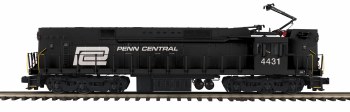
PC E44 ELECTRIC 4431
Product code: 2057471
$599.99
Description
PREORDER
O Scale Premier PC E44 Electric Engine With Proto-Sound 3.0
Roadname: PC
Cab/Car Number: 4431
Overview
Journey back to a time when electric giants ruled the rails of the bustling Northeast Corridor. The E-44 Rectifier Electric Locomotive model isn't just a train; it's a testament to raw power, engineering innovation, and a pivotal era in American railroading.
Commissioned by the mighty Pennsylvania Railroad (PRR) in the early 1960s, the E-44s were designed to usher in a new age of high-speed, heavy-duty electric freight and passenger service. With 4,400 horsepower at their command, these formidable locomotives easily outclassed their predecessors, becoming the dominant motive power under the PRR's extensive catenary system. What made them truly revolutionary was their use of then-modern ignitron rectifiers, converting the overhead AC current into DC power for their powerful traction motors – a technology that significantly boosted efficiency and capability. They served valiantly through the PRR, Penn Central, and early Conrail years, shaping the landscape of electrified rail.
The operating history of the Rectifier Electric Locomotive dates back to the 1890s when Peter Cooper-Hewitt discovered how a mercury rectifier actually works. About the same time, Charles Steinmetz of General Electric (GE) was also working on this operating principle to identify converters for commercial and industrial applications for the process. A railway vehicle application occurred in 1906, which initiated years of rail car experimentation on a few railroad lines. Following World War II, a device known as the Ignitron came to the forefront in the experimentation of rectifier technology. The use of the Ignitron on railway units helped to open the door for electrification and modernization of railroads.
Features
Intricately Detailed, Durable ABS Body
Die-Cast Truck Sides, Pilots and Fuel Tank
Metal Chassis
Metal Handrails and Horn
Metal Body Side Grilles
(2) Handpainted Engineer Cab Figures
Authentic Paint Scheme
Metal Wheels, Axles and Gears
(2) Remote-Controlled Proto-Couplers
O Scale Kadee-Compatible Coupler Mounting Pads
Prototypical Rule 17 Lighting
Directionally Controlled Constant Voltage LED Headlights
Lighted LED Cab Interior Light
Illuminated LED Number Boards
Lighted LED Marker Lights
(2) Precision Flywheel-Equipped Motors
Manually Operating Pantographs
Onboard DCC/DCS Decoder
Locomotive Speed Control In Scale MPH Increments
1:48 Scale Proportions
Proto-Sound 3.0 With The Digital Command System Featuring Freight Yard Proto-Effects
Unit Measures: 16 7/16” x 2 1/2” x 3 1/2”
Operates On O-42 Curves Diesel DCC Features
F0 Head/Tail light
F1 Bell
F2 Horn
F3 Start-up/Shut-down
F4 PFA
F5 Lights (except head/tail)
F6 Master Volume
F7 Front Coupler
F8 Rear Coupler
F9 Forward Signal
F10 Reverse Signal
F11 Grade Crossing
F12 Panto Auto/Manual
F13 Front Panto Up/Down
F14 Rear Panto Up/Down
F15 Idle Sequence 2
F16 Idle Sequence 1
F17 Extended Start-up
F18 Extended Shut-down
F19 Smoke On/Off
F20 Smoke Volume
F21 One Shot Doppler
F22 Coupler Slack
F23 Coupler Close
F24 Single Horn Blast
F25 Engine Sounds
F26 Brake Sounds
F27 Cab Chatter
F28 Feature Reset
O Scale Premier PC E44 Electric Engine With Proto-Sound 3.0
Roadname: PC
Cab/Car Number: 4431
Overview
Journey back to a time when electric giants ruled the rails of the bustling Northeast Corridor. The E-44 Rectifier Electric Locomotive model isn't just a train; it's a testament to raw power, engineering innovation, and a pivotal era in American railroading.
Commissioned by the mighty Pennsylvania Railroad (PRR) in the early 1960s, the E-44s were designed to usher in a new age of high-speed, heavy-duty electric freight and passenger service. With 4,400 horsepower at their command, these formidable locomotives easily outclassed their predecessors, becoming the dominant motive power under the PRR's extensive catenary system. What made them truly revolutionary was their use of then-modern ignitron rectifiers, converting the overhead AC current into DC power for their powerful traction motors – a technology that significantly boosted efficiency and capability. They served valiantly through the PRR, Penn Central, and early Conrail years, shaping the landscape of electrified rail.
The operating history of the Rectifier Electric Locomotive dates back to the 1890s when Peter Cooper-Hewitt discovered how a mercury rectifier actually works. About the same time, Charles Steinmetz of General Electric (GE) was also working on this operating principle to identify converters for commercial and industrial applications for the process. A railway vehicle application occurred in 1906, which initiated years of rail car experimentation on a few railroad lines. Following World War II, a device known as the Ignitron came to the forefront in the experimentation of rectifier technology. The use of the Ignitron on railway units helped to open the door for electrification and modernization of railroads.
Features
Intricately Detailed, Durable ABS Body
Die-Cast Truck Sides, Pilots and Fuel Tank
Metal Chassis
Metal Handrails and Horn
Metal Body Side Grilles
(2) Handpainted Engineer Cab Figures
Authentic Paint Scheme
Metal Wheels, Axles and Gears
(2) Remote-Controlled Proto-Couplers
O Scale Kadee-Compatible Coupler Mounting Pads
Prototypical Rule 17 Lighting
Directionally Controlled Constant Voltage LED Headlights
Lighted LED Cab Interior Light
Illuminated LED Number Boards
Lighted LED Marker Lights
(2) Precision Flywheel-Equipped Motors
Manually Operating Pantographs
Onboard DCC/DCS Decoder
Locomotive Speed Control In Scale MPH Increments
1:48 Scale Proportions
Proto-Sound 3.0 With The Digital Command System Featuring Freight Yard Proto-Effects
Unit Measures: 16 7/16” x 2 1/2” x 3 1/2”
Operates On O-42 Curves Diesel DCC Features
F0 Head/Tail light
F1 Bell
F2 Horn
F3 Start-up/Shut-down
F4 PFA
F5 Lights (except head/tail)
F6 Master Volume
F7 Front Coupler
F8 Rear Coupler
F9 Forward Signal
F10 Reverse Signal
F11 Grade Crossing
F12 Panto Auto/Manual
F13 Front Panto Up/Down
F14 Rear Panto Up/Down
F15 Idle Sequence 2
F16 Idle Sequence 1
F17 Extended Start-up
F18 Extended Shut-down
F19 Smoke On/Off
F20 Smoke Volume
F21 One Shot Doppler
F22 Coupler Slack
F23 Coupler Close
F24 Single Horn Blast
F25 Engine Sounds
F26 Brake Sounds
F27 Cab Chatter
F28 Feature Reset
Reviews
Customer Reviews
This product has not yet been reviewed.
Share:
Share on Facebook Share on Twitter Share on Pinterest Tell a friend